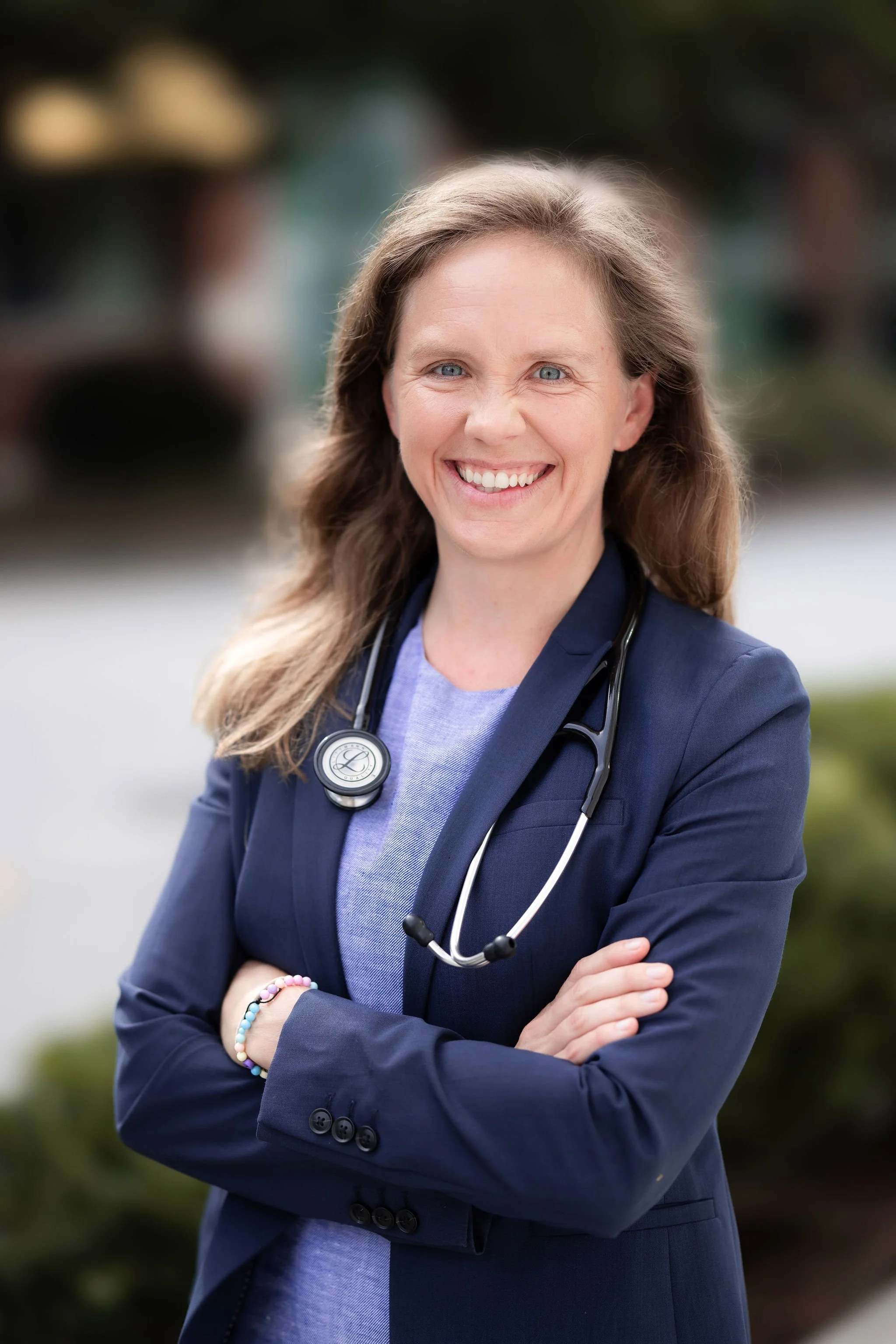
About Charlotte
I became a doctor because I wanted to help people in their hardest moments.
What I didn't fully anticipate was how often the hardest moment is not the medical situation itself — it's the confusion that surrounds it.
The diagnosis that gets delivered in five minutes and takes weeks to process. The specialist who explains a treatment plan in technical language and then moves on to the next patient. The hospitalization that ends with a discharge summary no one reads because no one explains what it means. The family sitting in a waiting room, trying to hold it together, with no one to tell them what's actually happening in language they understand.
I've watched this play out hundreds of times in the emergency department. And I've seen what happens when a trusted expert sits down, slows things down, and explains.
It changes everything.
---
My background
I've been an emergency physician for over a decade. The ER is a particular kind of environment — one where complexity arrives all at once, where information is often incomplete, where specialists are consulted and multiple systems intersect, and where someone has to synthesize all of it into a coherent picture and communicate it clearly to a scared, physically uncomfortable patient and their family.
That's my job. It's what I've trained for, and it's what I'm good at.
Over time, I began to notice a gap. The synthesis I provide in the ER — the clear explanation, the integrated picture, the honest conversation about what's happening and what comes next — doesn't reliably happen anywhere else in the system. Patients leave the hospital without understanding what occurred. Families receive a serious diagnosis and spend weeks trying to piece together what it means from Google searches and fragmentary conversations with busy physicians. Adult children watch their aging parents accumulate providers and medications with no one ever looking at the whole picture.
The medical system produces an enormous amount of information. What it rarely produces is clarity.
---
Why I started educating outside the ER
I've been doing this for years in an informal capacity — for friends, for family members of colleagues, for people who found their way to me and needed someone to help them make sense of what they were facing.
In every case, the experience was the same: relief. Not because I told them anything magical, but because someone finally sat with them, went through everything carefully, and explained it in a way that made sense. Because they finally felt like they understood what was happening to someone they loved.
That experience — of clarity arriving after a period of confusion and fear — is what this work is about.
I'm not offering a clinical service. I'm not your doctor or your loved one's doctor, and nothing we do together replaces the advice of your treating physicians. What I'm offering is the thing that so often falls through the cracks: a careful, experienced, unhurried review of your situation, explained in plain language, so you can show up to your medical team informed, prepared, and able to advocate effectively.
---
Who I am outside this work
I'm also a founder. I've built and led a venture-backed healthcare company, which gave me a different kind of education in how healthcare systems work — and don't work — from the outside.
I'm a runner. I've completed a 200-mile ultramarathon, which gave me a particular appreciation for what it means to keep moving through something hard when the end isn't yet visible.
I'm a mom, a wife, and someone who has sat on the other side of this experience — afraid, overwhelmed and uncertain about what a certain medical situation might mean for one of “my people”.
That experience stays with me in this work.
---
A note on credentials
I share these not to impress but because they're relevant to what I'm offering. You're trusting me with something important, and you should know who I am.
Certified by American Board of Emergency Medicine
Chief Resident, Carolinas Medical Center
MBA candidate at Harvard Business School (first-year honors)
MD from Perelman School of Medicine (attended on merit scholarship)
BA in Neuroscience from University of Pennsylvania (summa cum laude)
---
If you're wondering whether this is right for your situation
The best way to find out is to talk. The intro call is 20 minutes. You tell me what's happening. I'll tell you honestly whether I think I can help.
If I can't, I'll tell you that too — and do my best to point you toward someone who can.
Not ready for a call? Email me a brief description of your situation and I'll let you know if it's a fit.